


Bespoke Silver Service Training

Impeccable Service in Your Home — Without Constant Instructions or Outside Staff
An expert visits your property, assesses your household staff and provides practical training in professional table setting and service standards using the tableware, cutlery, glassware, linens and equipment available in your home.
This is not a standard course. It is a bespoke setup of your private service system, tailored to the family’s routine, preferred event formats, the specifics of the property and the required level of service.
From 1 to 5 days · For one employee or an entire team · UAE and international locations · Strict confidentiality


Service That Works Without Constant Instructions
In a high-end household, impressions are shaped by details: perfectly polished glassware, appropriate table settings, the correct order of service, calm movements, professional discretion and attentive care for guests.
However, if the principal has to ask staff to bring cutlery, replace a glass, clear plates or serve the next course during breakfast, a family dinner or a reception, the service has not been established as a reliable system.
On-site training is recommended if:
- staff members interpret service standards differently;
- the table setting does not match the menu or occasion;
- staff appear uncertain, rushed or intrusive;
- the order of service and service rules are not followed;
- staff roles are not clearly allocated;
- valuable tableware, glassware and linens are handled incorrectly;
- the team waits for instructions from the principal or household manager;
- mistakes recur after corrective feedback;
- coordination between service staff and the kitchen is ineffective;
- new employees have to learn through trial and error.
A single awkward incident during an important reception can affect the guests’ overall impression. Incorrect handling of collectable tableware, crystal, silver or delicate linens may also result in costly damage.
The project transforms table setting and service from a series of isolated actions into a controlled system with consistent standards, clearly defined roles and predictable results.
Training Takes Place at Your Property
The trainer visits your apartment, private home, residence, villa, yacht, private aircraft or corporate representative office.
The programme is developed with consideration for:
- the family’s routine and requirements;
- daily and event service formats;
- the size and qualifications of the staff team;
- the layout of the dining room, kitchen and service areas;
- the available tableware, cutlery, glassware and linens;
- menus and preferred styles of service;
- the allocation of responsibilities;
- upcoming events;
- previous incidents and recurring mistakes;
- the required standard of service.
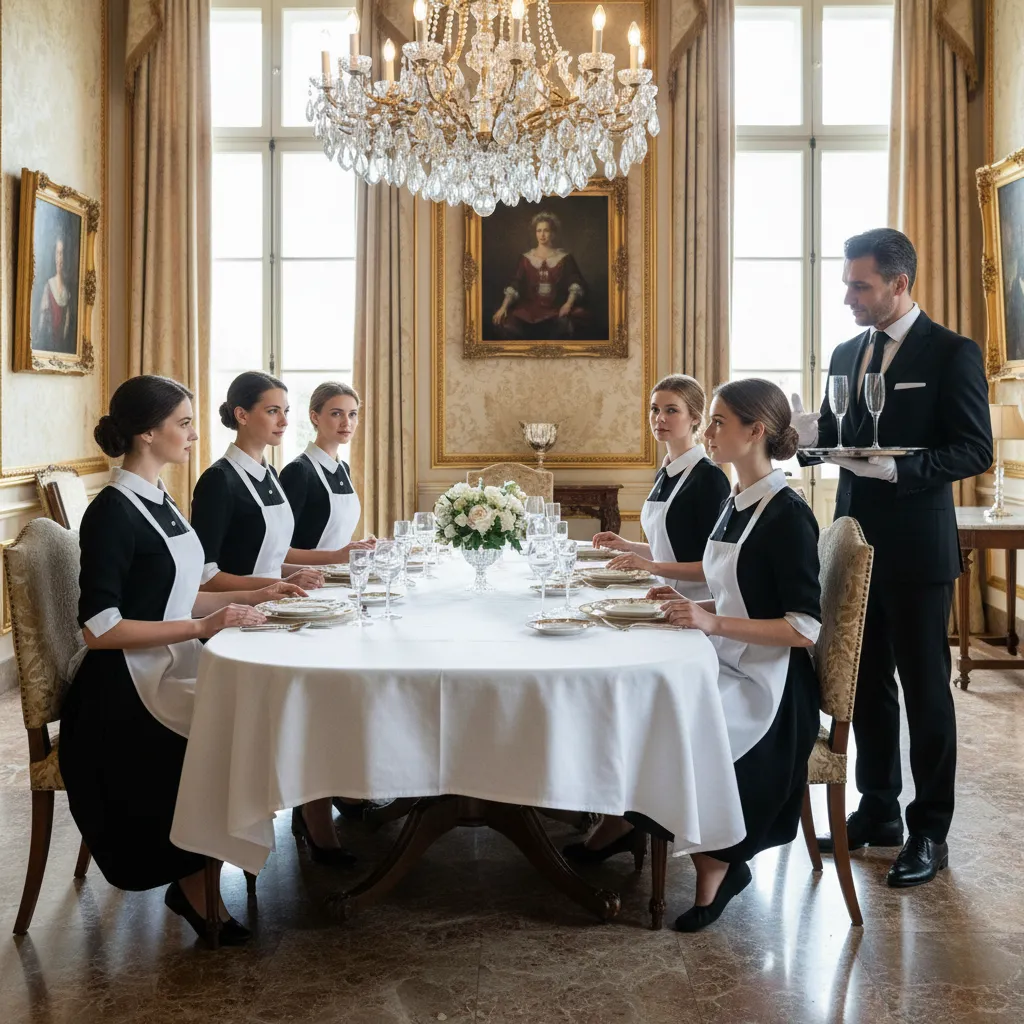
Employees set the table and perform real or simulated service scenarios. The expert observes their work, identifies shortcomings and immediately corrects their technique, sequence of actions, communication and teamwork.
Recommendations are developed not for a hypothetical restaurant, but for a specific home, family and household team.

How an On-Site Project Differs from a Standard Course
A group course provides essential knowledge of table setting and service. On-site training addresses the specific requirements of your household.
The trainer works with your property, tableware, glassware, linens, menus, staff and existing procedures. The client receives not only training, but also an assessment of service risks, practical correction of mistakes, recommendations regarding equipment and tools for ongoing quality control.
This enables the new standards to be applied immediately in daily work and prevents situations where an employee completes a course but continues to follow old habits in the household.

What the Principal and Household Manager Receive
The principal receives
- professional service without constant instructions;
- the freedom to focus on family and guests rather than supervising staff;
- a consistent standard of service across different shifts;
- discreet, calm and unobtrusive staff presence;
- a reduced risk of damage to valuable tableware, glassware and linens;
- the ability to host receptions using trusted household staff;
- greater household privacy without regularly inviting outside waiting staff;
- confidence that employees understand the family’s preferences and expectations.
The household manager receives
- an independent assessment of staff competence;
- consistent table-setting and service standards;
- clear allocation of roles;
- procedures for coordination between service staff and the kitchen;
- tools for monitoring the preparation and delivery of receptions;
- recommendations regarding equipment and the organisation of service areas;
- a plan for correcting identified shortcomings;
- a framework for onboarding new employees.
Train Your Trusted Team and Preserve Household Privacy
Hiring outside waiting staff for every reception means allowing new people into the home who are unfamiliar with the family’s preferences, the property and its internal protocols.
In many cases, it is safer and more effective to train your own housekeepers, housemaids, butlers, household assistants, chefs or private waiters. They already know the home and the principals; we equip them with professional standards, service techniques and the culture of premium private service.
The programme is suitable for:
- housekeepers and housemaids with service responsibilities;
- private waiters;
- butlers;
- private household managers;
- chefs involved in food presentation and service;
- yacht stewardesses;
- private aviation cabin crew;
- staff of corporate representative offices;
- teams supporting private family and business receptions.
How the Project Works
1. Confidential Consultation
We discuss the property, team structure, family lifestyle, current challenges, recurring mistakes, upcoming events, the principal’s expectations and the household manager’s objectives.
2. Assessment of the Property and Procedures
The trainer evaluates tableware, cutlery, glassware, linens, trays, service areas, storage, preparation procedures and the existing order of service. Specific incidents can also be reviewed when required.
3. Bespoke Programme
We establish priorities and include only relevant topics, from daily breakfasts to formal receptions, wine service, Silver Service and gueridon service.
4. Practical Training
Employees set tables and perform real or simulated service scenarios. Mistakes are reviewed and corrected during the practical work.
5. Staff Assessment
Depending on the selected project format, we assess knowledge, technique, attentiveness, accuracy, discipline, ability to learn, response to feedback, teamwork and capacity for independent work.
6. Recommendations and Implementation Plan
The client receives independent conclusions regarding staff, procedures, equipment, allocation of responsibilities and recommended next steps.
Bespoke Training Programme
The content and duration are determined after the consultation and initial assessment.
1. Private Luxury Service Standards
- differences between restaurant service and service in a private household;
- expectations of principals and guests;
- formal and informal service;
- professional ethics and reporting lines;
- confidentiality and personal boundaries;
- appearance, hygiene and personal presentation;
- posture, facial expression, body language and speech;
- appropriate professional distance;
- quiet and unobtrusive presence;
- attention to detail;
- anticipating guests’ needs.
2. Service Mindset
- understanding the event scenario;
- preparing without additional reminders;
- observing the table and guests;
- responding promptly to guests’ needs;
- calm communication;
- interaction with the principal and household manager;
- responding professionally to feedback;
- taking responsibility for the result;
- working without rushing or becoming intrusive;
- maintaining confidentiality.
3. Preparing the Table and Service Area
- reviewing the menu and event scenario;
- selecting tableware, cutlery, glassware and linens;
- laying and changing tablecloths;
- folding linen napkins;
- polishing cutlery, glassware, silver and tableware;
- guest seating arrangements;
- table decoration and styling;
- organising the waiter’s station;
- preparing service areas;
- safe transportation of food;
- professional tray handling.
4. Practical Table Setting
- breakfast table setting;
- lunch table setting;
- dinner table setting;
- tea and coffee table setting;
- family-style table setting;
- festive table setting;
- business and intimate receptions;
- caviar service;
- wine and champagne service;
- serving spirits and non-alcoholic beverages;
- adapting the table setting to the menu and guest profile.
5. Table Service
- welcoming and seeing off guests;
- service order and sequence;
- serving and presenting dishes;
- replacing cutlery and glassware;
- clearing the table;
- moving correctly through the service space;
- working efficiently without rushing;
- observing the table;
- coordinating with the kitchen;
- allocating staff roles;
- sharing information between team members;
- responding to menu changes;
- handling unexpected situations.
6. Types and Techniques of Service
Depending on the property’s requirements, training may include:
- family service;
- plate service;
- buffet service;
- Silver Service;
- French service;
- English service;
- American service;
- Russian service;
- gueridon service.
7. Handling Valuable Service Items
- safe handling of porcelain and ceramics;
- working with crystal and fine glassware;
- care of silver and silver-plated items;
- storage of cutlery, tableware and linens;
- preventing chips, scratches and tarnishing;
- correct washing, drying and polishing;
- recording and moving valuable items;
- procedures in the event of damage;
- recognising situations that require a specialist.
8. Organising the Service Team
- allocating duties;
- assigning responsibility for key procedures;
- preparing an event schedule;
- coordinating the kitchen and service team;
- pre-event briefings;
- shift handover;
- recording tableware, linens and equipment;
- procedures for damage and incidents;
- organising storage and service areas;
- purchasing and stock control;
- onboarding new employees.
Project Deliverables
Depending on the selected format, the client receives:
- an assessment of service risks;
- bespoke practical training;
- a list of critical errors;
- an assessment of employees’ knowledge, skills and ability to learn;
- a consistent table-setting and service standard;
- recommendations regarding the allocation of roles;
- an audit of tableware, glassware, linens and equipment;
- recommendations for organising service areas;
- procedures for coordination between service staff and the kitchen;
- checklists and working documents;
- a responsibility matrix;
- a corrective action plan;
- a report for the principal or household manager.
Each participant receives a personalised certificate, training materials and 30-day access to a relevant online course to reinforce their knowledge.
Control Tools for the Household Manager
On-site training can be supplemented by the development of a management framework:
- standard operating procedures;
- checklists for breakfast, lunch and dinner table settings;
- standards for preparing tableware, glassware and linens;
- service procedure cards;
- a responsibility matrix;
- procedures for coordination between service staff and the kitchen;
- a shift handover form;
- a guest-arrival preparation plan;
- a damage and incident log;
- an issue-escalation procedure;
- standards for handling unexpected situations;
- onboarding materials for new employees.
This ensures that knowledge remains within the household even when employees leave, while the household manager receives the tools required to maintain standards and monitor performance.
We do not replace the household manager or assess them in front of the team. Our role is to provide independent professional tools, strengthen discipline and make service quality measurable.
Train, Restrict Responsibilities or Replace?
If an employee is reliable, loyal and well suited to the family, professional training is often more effective than hiring someone new.
The assessment helps determine whether the employee:
- meets the requirements;
- can achieve the required standard after training;
- needs additional practice or supervision;
- can safely perform a limited range of service duties;
- does not demonstrate the required attentiveness, ability to learn or sense of responsibility.
The client receives a neutral professional recommendation: develop the employee, adjust their responsibilities, increase supervision or consider replacement.
The final staffing decision always remains with the client.
Project Formats
Silver Service Training
Suitable when the objective is to identify the main service risks and improve the performance of one employee or an entire team.
Includes:
- assessment of the property and procedures;
- a bespoke programme;
- practical training;
- practice of relevant scenarios;
- review of critical mistakes;
- recommendations concerning tableware, glassware, linens and equipment;
- training materials for participants.
Control
Suitable when the objective is to train employees, assess the team and strengthen managerial control.
Includes everything in the “Training” format, as well as:
- employee assessments;
- a working session with the household manager;
- recommendations regarding the allocation of roles;
- a procedure for coordination between service staff and the kitchen;
- a corrective action plan;
- a report for the client;
- a follow-up assessment after 30–45 days.
System
Suitable for establishing a comprehensive service structure within a residence and implementing consistent standards.
Includes everything in the “Control” format, as well as:
- development of standard operating procedures;
- table-setting and service checklists;
- service procedure cards;
- a responsibility matrix;
- shift handover forms;
- procedures for recording damage and incidents;
- onboarding materials for new employees;
- implementation support.
The final cost depends on the location, team size, number of service scenarios, property equipment, project duration and volume of required documentation. Travel, visa and business-trip expenses are calculated separately.
Duration
Practical training lasts from 1 to 5 days, with 8 hours of training per day.
For large residences, multiple shifts, preparation for a complex event or comprehensive implementation of standards, the duration may be extended. The most suitable format is determined after a confidential consultation.
The trainer and the agency director may visit the property together. The trainer is responsible for assessment and practical instruction, while the agency director ensures that the project meets the client’s objectives and assesses the organisation of the household team.
The Expert
The training is delivered by an expert in restaurant service and luxury hospitality with more than 20 years of professional experience.
His experience includes positions as a private waiter, butler, maître d’, restaurant manager and banquet service manager. He has worked with The Ritz-Carlton, Marriott, Kempinski, Lotte Hotel, Radisson, Hyatt and Mövenpick.
He has served private families and high-profile individuals internationally.
Areas of expertise:
- daily, festive and banquet table settings;
- service for private and business receptions;
- food and beverage service;
- wine service;
- Silver Service;
- the work of butlers and private waiters;
- development of standards and checklists;
- training in professional guest interaction;
- business and private etiquette;
- staff procedures in unexpected situations.
Follow-Up Assessment After 30–45 Days
A follow-up visit determines whether the new standards have become part of the team’s daily work.
The expert reviews:
- implementation of the recommendations;
- the quality of table settings;
- compliance with the correct sequence and techniques of service;
- handling of tableware, glassware and linens;
- allocation of roles;
- coordination between service staff and the kitchen;
- use of checklists and procedures;
- recurring mistakes and incidents;
- the team’s ability to work without constant instructions;
- the effectiveness of supervision by the household manager.
The client receives a comparative analysis, an updated risk map, conclusions regarding employees and an action plan for the next 30–90 days.
The follow-up assessment is included in the “Control” and “System” formats. It can be booked separately for the “Training” format.
Locations and Confidentiality
The agency provides training in Dubai, Abu Dhabi, across the UAE and internationally, including London and destinations throughout Europe.
For international projects, a foreign trainer from an international butler academy in London or another European location may be engaged. The expert is selected according to the project objectives, the client’s requirements and the location of the property.
The project can take place:
- in an apartment or serviced residence;
- in a private home or residence;
- at a villa;
- on a yacht;
- on board a private aircraft;
- in a corporate representative office.
Travel arrangements are agreed individually.
All information concerning the family, guests, staff, daily routine, events, property and possessions remains strictly confidential. Assessment results are provided only to the client or their authorised representative and are not discussed in front of the team.
An NDA can be signed upon request.
Request a Preliminary Project Plan
Tell us about your property, staff structure, preferred service formats and recurring issues. We will clarify your objectives and recommend the appropriate project duration, programme and format.
The principal enjoys the occasion. The household manager controls the result. The team performs professionally without constant instructions.